Liquid net worth. – As we delve into the world of liquid net worth, it’s clear that the key to unlocking financial freedom lies not in a singular strategy, but rather in a symphony of unconventional investment methods, meticulously crafted to amplify your returns while minimizing risks. With the right mix of assets, allocated with precision and foresight, you can create a safety net that safeguards your financial well-being against life’s unforeseen twists.
But what exactly is liquid net worth, and how can you harness its power to catapult your finances to new heights? In this comprehensive guide, we’ll embark on a fascinating journey to explore the intricacies of liquid net worth, debunk common misconceptions, and offer actionable advice to supercharge your financial trajectory.
Join us as we explore how strategic investment, shrewd asset allocation, and a deep understanding of financial goals can work in tandem to fuel your financial objectives. We’ll examine the importance of building a liquid safety net, discuss the most effective investment strategies, and shed light on the often-misunderstood concepts of liquidity and total net worth.
Unconventional Investment Strategies to Boost Liquid Net Worth

Liquid net worth is the foundation of financial stability, and for those seeking to fortify their financial position, exploring innovative investment methods can be a game-changer. These unconventional strategies can not only minimize risk but also generate substantial returns, setting one up for long-term financial success.To achieve financial freedom, it’s essential to think outside the box when investing your money.
Here, we’ll delve into five unique investment strategies that have proven to be effective in generating substantial returns.
Impact Investing: Tapping into Social and Environmental Causes
Impact investing is a relatively new phenomenon that involves investing in companies and projects dedicated to creating positive social and environmental impact. This investment method not only generates returns but also contributes to the betterment of society and the environment.
- Impact investments can be made through impact funds, social venture capital, and even crowdfunding platforms.
- The primary goal of impact investing is to create a positive impact, whether it be reducing carbon emissions, providing access to clean water, or promoting social justice.
- Impact investing has gained significant traction in recent years, with many investors seeking to allocate a portion of their portfolio to impact investments.
For instance, a successful impact investment is the Green Belt Movement in Kenya, which focused on reforestation and community development. The movement employed women in tree-planting activities, providing them with an opportunity to earn income while improving their environment. The movement’s success led to significant returns, not only financially but also environmentally and socially.
Angel Investing: Nurturing the Next Generation of Innovators, Liquid net worth.
Angel investing is a type of equity investment where high-net-worth individuals invest in startups and early-stage companies in exchange for equity. Angel investors play a crucial role in funding innovative ventures, providing valuable guidance and resources to help them grow.
- Angel investors typically invest smaller amounts of money, usually between $25,000 and $500,000.
Successful angel investing examples abound, such as Accel Partners’ investment in Facebook, which provided the company with the necessary funding to expand its operations and ultimately become a global phenomenon.
Crowdfunding: Unlocking Investment Opportunities for the Masses
Crowdfunding is a relatively new investment method that allows individuals to invest small amounts of money in companies, projects, or individuals in exchange for rewards or equity. This democratization of investment has opened up opportunities for those who may not have had access to traditional investment channels.
- There are three primary types of crowdfunding: rewards-based, equity-based, and lending-based.
A pioneering example of successful crowdfunding is the Kickstarter campaign for Pebble Watch, a smartwatch that gained significant traction and funding through the platform.
Real Estate Crowdfunding: Diversifying Your Portfolio with Property Investments
Real estate crowdfunding involves investing in real estate through online platforms, allowing individuals to diversify their portfolios and potentially generate significant returns.
- Real estate crowdfunding platforms provide investors with the opportunity to invest in a range of properties, from residential to commercial.
A prime example of successful real estate crowdfunding is the Fundrise platform, which provided investors with the opportunity to invest in a diversified portfolio of commercial properties.
Robo-Advisory Investing: Leveraging AI-Powered Investment Strategies
Robo-advisory investing involves using automated investment platforms that employ artificial intelligence and machine learning algorithms to create and manage investment portfolios.
- Robo-advisors offer a range of benefits, including low fees, diversification, and tax optimization.
A notable example of successful robo-advisory investing is the Betterment platform, which provided investors with a tailored investment strategy and significantly reduced fees.
Peer-to-Peer Lending: Investing in Human Capital
Peer-to-peer lending involves lending money to individuals or businesses in exchange for interest on the loan. This investment method has gained significant traction in recent years, providing investors with a unique opportunity to generate returns while supporting small businesses and entrepreneurs.
- Peer-to-peer lending platforms provide investors with the opportunity to lend to a diversified portfolio of borrowers.
A successful peer-to-peer lending example is the Lending Club platform, which provided investors with the opportunity to lend to a range of borrowers, including small business owners and individuals with good credit.
Building a Safety Net with Liquid Assets

In the ever-shifting landscape of personal finance, it’s essential to have a safety net in place to mitigate the impact of unexpected expenses, job loss, or medical emergencies. Liquid assets, easily convertible to cash, are the key to building this safety net.Having a well-stocked safety net can be the difference between financial stability and chaos. When liquid assets are readily available, you can cover unexpected expenses, avoid debt, and maintain a sense of financial security.
Liquid Assets as a Safety Net
When it comes to liquid assets, you have several options to consider. Here are a few examples:
| Asset Type | Liquidity | Example |
|---|---|---|
| Cash | High | Money in a savings account, a short-term CD, or under your mattress. |
| High-Yield Savings Accounts | High | A savings account with a variable interest rate, often linked to a checking account. |
| Money Market Funds | Medium to High | A professionally managed pool of low-risk, short-term investments. |
These liquid assets serve as a vital component of your safety net, ensuring you have the funds to cover essential expenses when unexpected costs arise.
Prioritizing Liquid Assets
To optimize the effectiveness of your safety net, consider the following ways to prioritize and allocate your liquid assets:When building a safety net, it’s essential to prioritize your liquid assets based on their liquidity, safety, and growth potential. Here is a suggested framework to allocate your liquid assets:
- Emergency fund: Allocate 3-6 months’ worth of expenses to a readily accessible savings account or money market fund.
- Short-term goals: Invest in high-yield savings accounts or short-term CDs for goals that require a specific timeline, such as a down payment on a house.
- Long-term goals: Invest in low-risk, long-term instruments such as money market funds or short-term bonds for goals that have a longer time horizon, such as retirement.
- Ongoing expenses: Consider investing in dividend-paying stocks or short-term bonds to cover ongoing expenses.
By prioritizing your liquid assets, you can maintain a safety net that adapts to your ever-changing financial situation.
The Importance of an Emergency Fund
An emergency fund serves as the cornerstone of your safety net. When unexpected expenses arise, this fund helps prevent financial chaos by providing a readily available source of cash.A well-maintained emergency fund can cover 3-6 months’ worth of essential expenses, including:
- Rent/mortgage and utilities
- Food and groceries
- Transportation costs (e.g., car payment, insurance, gas)
- Minimum debt payments (e.g., credit cards, loans)
- Medical expenses
- Other essential expenses
While building an emergency fund takes time and discipline, it’s essential for maintaining a sense of financial security.Maintaining a well-funded safety net requires ongoing effort and discipline, but the benefits are immeasurable. By prioritizing your liquid assets, establishing an emergency fund, and regularly reviewing your safety net, you’ll be better equipped to handle unexpected expenses and stay on track with your long-term financial goals.
Measuring Liquid Net Worth: An In-Depth Explanation

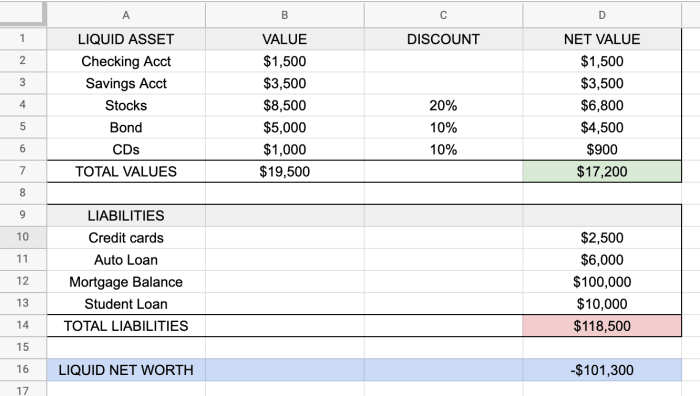
When it comes to managing your finances, understanding your liquid net worth is crucial. Unlike total net worth, which encompasses all your assets, liquid net worth focuses on the value of your easily accessible and convertible assets. This distinction is essential, as it helps you allocate your resources efficiently and make informed decisions about your financial future. Liquid net worth and total net worth may seem similar, but they serve different purposes.
Total net worth includes all your assets, such as real estate, investments, and cash, minus your liabilities. On the other hand, liquid net worth considers only those assets that can be quickly converted into cash without significant loss of value. This category typically includes cash, savings accounts, short-term bonds, and stocks that can be easily sold. Two common assets that are not considered liquid are real estate and retirement accounts.
These assets may take time to sell or access, and doing so might result in significant financial repercussions. For instance, selling a primary residence can be a lengthy and costly process, while withdrawing from a retirement account often incurs penalties and taxes. To calculate and track your liquid net worth over time, follow these steps:
Liquid Net Worth = (Liquid Assets – Non-Essential Liabilities) / 3-6 months of essential living expenses
Essential living expenses include necessities like rent/mortgage, utilities, food, and healthcare costs. Non-essential liabilities, on the other hand, are debts you can live without, such as credit card balances or personal loans.
| Asset Type | Value | Liquidity | Frequency of Use | Contribution |
|---|---|---|---|---|
| Cash | $10,000 | High | Infrequent | 10% |
| Savings Account | $20,000 | Medium | Frequent | 15% |
| Short-Term Bond | $30,000 | Medium | Occasional | 5% |
| Stocks (Easily Saleable) | $40,000 | Low | Rarely | 2% |
Minimizing Tax Liabilities with Strategic Liquid Asset Management
In today’s financial landscape, maximizing your returns while minimizing tax liabilities is crucial for building and maintaining a robust liquid net worth. With the right strategies in place, you can optimize your liquid asset management and reduce your tax burden, freeing up more funds for your financial goals. In this section, we’ll delve into the world of tax-advantaged accounts, explore methods for minimizing tax liabilities, and examine the importance of regular tax strategy reviews.
Tax-Advantaged Accounts: A Cornerstone of Liquid Net Worth
A tax-advantaged account is essentially a savings vehicle that allows your money to grow tax-free or with reduced tax obligations. These accounts can be a valuable asset in your liquid net worth arsenal, providing a tax-efficient way to save for short-term and long-term goals. Common tax-advantaged accounts include:
- High-Yield Savings Accounts: These accounts offer a high-yield interest rate, often with tax benefits.
- Roth IRAs: Contributions are made with after-tax dollars, but withdrawals are tax-free.
- 401(k) or Employer-Sponsored Retirement Plans: Contributions and earnings grow tax-deferred, and withdrawals are taxed as ordinary income.
When selecting a tax-advantaged account, consider your financial goals, risk tolerance, and tax situation to maximize your benefits.
Strategies for Minimizing Tax Liabilities
Now that we’ve discussed tax-advantaged accounts, let’s explore two key strategies for minimizing tax liabilities when managing liquid assets:
-
Asset Location Optimization
By allocating your liquid assets across different tax-advantaged accounts, you can minimize tax liabilities and optimize your returns. For example, consider keeping highly taxed investments, such as bonds, in tax-deferred accounts, like 401(k)s or IRAs.Tax-efficient investing: allocating assets based on their tax characteristics.
-
Harvesting Tax Losses
If you’ve experienced losses in your investments, consider harvesting those losses to offset gains from other investments. This can help reduce your tax liability and maintain your liquid net worth.Example: You sell a losing stock, realizing a $5,000 loss. You can then use this loss to offset gains from other investments, reducing your tax liability.
Regular Tax Strategy Reviews: A Key to Unlocking Potential
With tax laws and rates frequently changing, it’s essential to regularly review and adjust your tax strategies to ensure you’re taking advantage of available deductions and credits. By doing so, you can optimize your liquid asset management and minimize tax liabilities, ultimately boosting your liquid net worth.
Tax planning is not a one-time task; regular reviews can help you stay ahead of the curve.
Essential FAQs: Liquid Net Worth.
Q: What is the average return on investment (ROI) for liquid net worth portfolios?
A: The ROI for liquid net worth portfolios can vary widely depending on market conditions, asset allocation, and investment strategies. However, a well-diversified liquid net worth portfolio can potentially return 4-8% per annum, above the 2-5% average for more conservative investments.
Q: Can I use liquid net worth to cover unexpected expenses, such as medical bills or car repairs?
A: Absolutely. One of the primary purposes of liquid net worth is to provide a readily accessible pool of funds for emergencies. By allocating a portion of your liquid net worth to a dedicated emergency fund, you’ll have peace of mind knowing you can cover unexpected expenses without jeopardizing your financial stability.
Q: How do I calculate my liquid net worth?
A: To calculate your liquid net worth, start by compiling a comprehensive list of your liquid assets, including cash, savings accounts, money market funds, bonds, and other easily convertible assets. Next, subtract any outstanding debts or liabilities to arrive at your total liquid net worth.
